
Current IAS Board Members
President
(Vacant)
Leslie Saxon West, Vice-President
I come to the world of Inuit art through my personal and professional endeavors. Prior to my retirement in 2016, I was a professor of Native American Art as well as Dance, Dance in World Cultures, and Dance History in Northern California. My husband Alan and I recently moved to Sequim, Washington, which is on the Olympic Peninsula and the ancestral home of the S’Klallam people. I enjoyed a 35-year career getting paid to teach about what I love! Since retiring, I have completed graduate work in Native American Studies at Montana State University and am currently enrolled in a certificate program in Native American Art History at the Institute of the American Indian Art in Santa Fe, New Mexico.
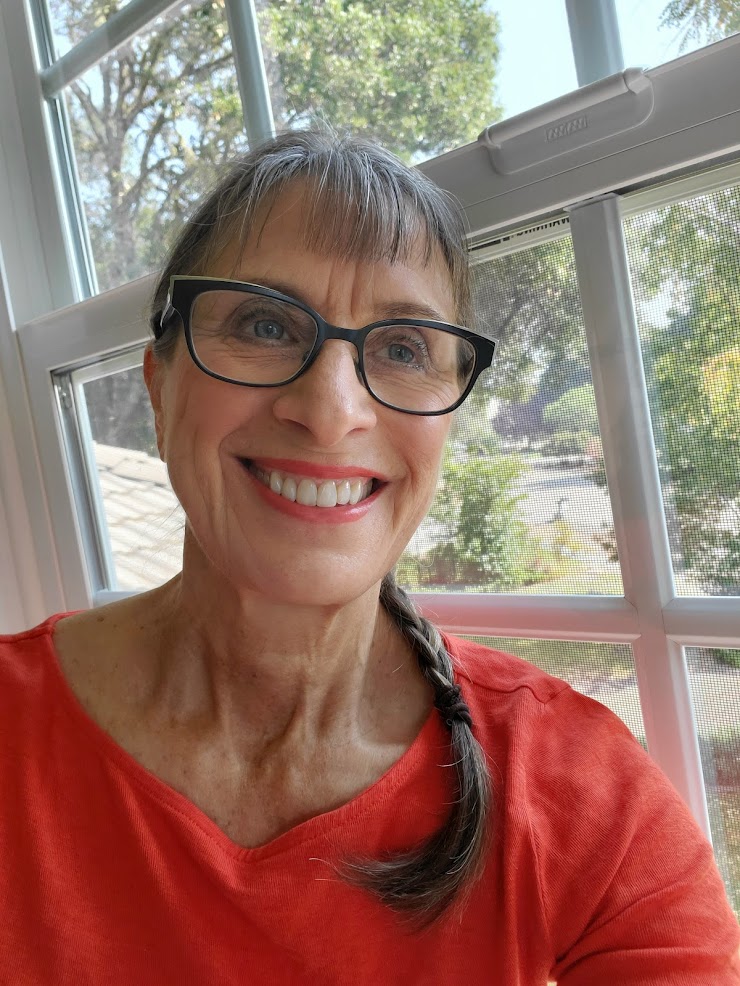
Although I love and appreciate all forms of Native American artistic expressions, I have always been particularly drawn to the indigenous cultural groups of the Pacific Northwest and the Arctic.
While on sabbatical in 2001 I spent a year in British Columbia, researching masked dance traditions of the Kwakwaka’wakw on Vancouver Island. It was during that time in Canada that I became enthralled with the art and culture of the Native peoples of the Arctic, specifically in Canada and Alaska. My keen interest in Yup’ik masks and dance traditions as well as utilitarian objects made from fish skin, seal intestine and the like, led me to many remote areas of Alaska, specifically Anaktuvuk Pass, Bethel, Kodiak Island, Nome, and Barrow. Since then, I have traveled to many remote Arctic communities in Canada including Kinngait, Coral Harbor, Arviat, and Iqaluit. I have also traveled to the Siberian Arctic.
In 2016, right before retiring, I curated an exhibit entitled STARK ABUNDANCE: Through the Eyes of Arctic First Peoples for the Mendocino College Art Gallery in Northern California. This expansive exhibit contained a variety of Inuit/Eskimo artworks with a focus of educating our college students and community members about the history, culture, and art of indigenous Arctic peoples. Coinciding with this exhibit I coordinated a series of community events consisting of public school and community tours, film screenings, and a more scholarly event connecting art, history, and science as a way of more deeply exploring environmental issues unique to the arctic and its inhabitants. Additionally, I presented an illustrated lecture entitled Sustainability, Subsistence, Survival and the Sacred: Through the Eyes of Arctic First Peoples in collaboration with Mendocino College and the Grace Hudson Museum, both in Ukiah, California.
Although I appreciate Inuit art of all kinds, my primary interests are in the contemporary realm, pieces by artists who utilize their traditional themes and techniques but are now working in new ways that challenge us to consider Inuit art as more than how we define it in traditional terms. I am particularly drawn to works of Canadian artists Maureen Gruben and Shuvinai Ashoona and as a performing artist myself, I am entranced with the work of Sobey Award winner Laakkuluk Williamson Bathory and vocalist Tanya Tagaaq. In terms of 3-dimensional forms, I am most drawn to pieces made of bone, particularly those created by Nick Sikkuark and Judas Ullulaq. Additionally, I am particularly interested in the work of Alaskan Native artists Sonya Kelliher-Combs (Inupiat/Athabascan) and contemporary Yup’ik mask maker Drew Michaels.
I see myself more as an educator and advocate as opposed to a collector. My primary interest is in bringing people together and to help facilitate learning opportunities that will hopefully bring about a deeper understanding and appreciation for Native peoples in North America.
Lou Jungheim, Treasurer
My interest in Inuit art was kindled in 1983 while attending a chemistry conference in Waterloo, Ontario. The university there had a small gallery and I fell in love with a whale sculpture on display. Later that week the plenary lecturers at the conference presented the organizer with this same sculpture so I know it has a good home! In 1991 I married Thalia, a Canadian citizen, thus my trips to Canada became frequent and my exposure to Inuit art much broader. I learned many Canadian homes have a soapstone carving.
We started small but after a couple of years another whale sculpture ”spoke to me“ and over the years our Inuit collection has grown significantly and includes carvings, original drawings, and prints. These are juxtaposed to a somewhat smaller collection works by other First Nations artists, an eclectic collection of oil paintings as well as motorsports images which include three Inuit race car carvings.
The IAS has been a wonderful find for us as we have been able to learn so much more about the culture and the art than we had been doing on our own. Meeting the artists who have presented at the annual meetings has been especially enriching. Perhaps more importantly we have been motivated to travel to Nunavut where we visited several artists in their homeland. These were life changing adventures.
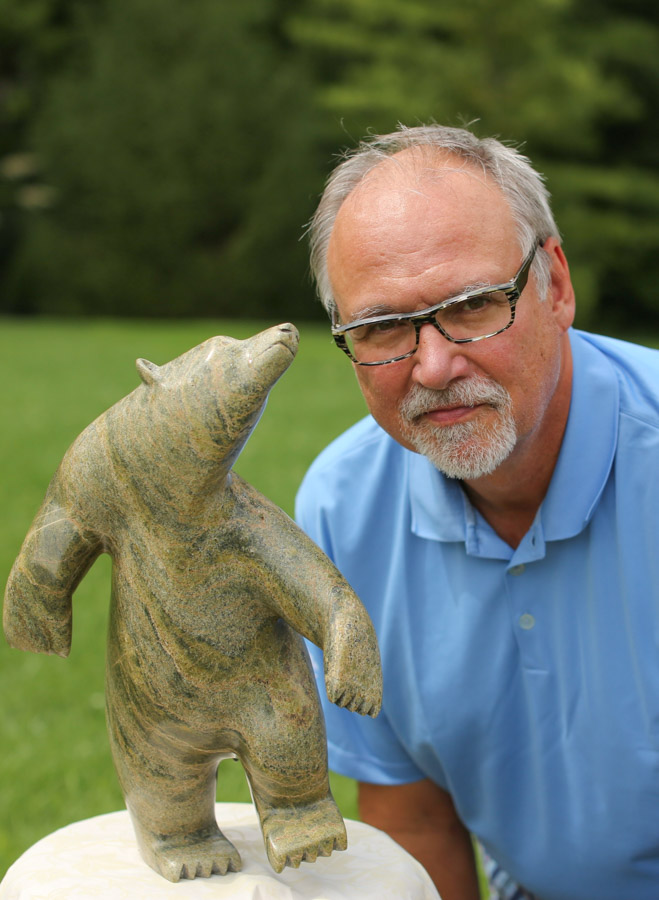
The photo of me includes a dancing bear by Ashevak Adla. The photo was included in an article I wrote and published by the American Chemical Society. The article was part of a series highlighting what scientist do with themselves after retiring.
It would be impossible to name a favorite artist, but some of my favorites include Nuna Parr, David and Abraham Ruben, Floyd Kuptana, John Tiktak, John Pangnark, Oviloo Tunillie, Kenojuak Ashevak, Toonoo Sharky, Michael Massie, Billy Gauthier, Jaco Ishulutaq, Pits Qimirpik (Kinngait), Uriash Puqiqnaq, George Tataniq, Tim Pitsiulak, Ningiukulu Teevee and Shuvinai Ashoona. The pieces were all selected for their ability to communicate, connect us to the Inuit culture, and stir our emotions. They also do a wonderful job of helping Thalia feel connected to her homeland.
It has been a pleasure to serve the IAS since 2012 in the roles of at-large board member, President, Vice President and now Treasurer.
Marie McCosh, Secretary
As a child I was always fascinated by the stories and accounts I read and heard about the Arctic. I imagined what it must be like to live in an igloo, drive a dog team or live without the sun for months.
My introduction to Inuit art was in 1973, after moving to Maine. A chance daytrip to St. Andrews, New Brunswick, brought me to the Sea Captain’s Loft, a gallery featuring Inuit art. I was awestruck! I selected several small pieces. However, one larger piece kept calling to me, a mother and child by Pauloosie Karpik. It is still one of my favorite pieces! My cats even like it – the stone is cool and nicely shaped for a cat’s pillow on a warm day. Over the years I continued to learn more about the far north, its people, culture, art, stories and folk lore, in short, about a way of life totally foreign to me.
Fast forward many years. In the early 2000’s I was lucky enough to travel with a small Inuit owned company. One day while walking in Cape Dorset a young boy approached me and hesitantly offered me a small inukshuk he had carved. Of course I bought it! He was delighted to get an American $5 bill and I was equally delighted to hold the small piece he had created. Unfortunately I neglected to ask his name.
My interest in, exposure to and knowledge of the Inuit people continued to grow. For several years Ohito Ashoona taught classes on Inuit Stone Carving through the North House Folk School in Grand Marais, Minnesota. Fortunately I was able to take several of those classes with Ohito. It still amazes me that he knew more about how a seal or a bear looks than I did about my own cats. He taught me a great deal about how to look at and perceive my environment, especially animals.
My involvement with the IAS has been wonderful. I’ve met many interesting people, forged some very nice lasting friendships and learned a vast range of information from the artists, presenters, other IAS members and locations of the annual meetings.
Textiles and pottery are also loves of mine. As a quilter I enjoy the juxtaposition of the softness of the fabric I work with and the smoothness and silkiness of much of the stone in the Inuit sculptures. I am also drawn to the texture of the fossilized bone used in many sculptures.
Over the years as I have expanded my collection of sculptures and prints, I have also acquired a few artifacts, dolls and children’s toys. While I do have my favorite artists, I purchase pieces that speak to me, irregardless of the artist or the medium. It seems I am most drawn to more traditional Inuit art, although my interest seems to be evolving with more exposure to contemporary art. And I do definitely enjoy the humor in some of the more contemporary pieces.
Being on the IAS Board has certainly been a privilege and a learning experience. Talking and sharing information with others who share a similar interest is always enlightening and meaningful. I believe it is important to contribute to the direction the IAS will take in the coming years.
Sheila Romalis, Board Member
I am an addict. Yes, I have an affliction, but I come by it honestly. I love rocks !!!
When I was 7 years old, in 2nd grade, we were given a project of producing a diorama, on any subject, in a shoe box. I had just seen a National Geographic magazine with an article about Canadian Inuit building igloos near Frobisher Bay. This fascinated me, so I produced my diorama of an Inuit village using eggshells for igloos, cotton batting for snow, toothpicks for a ‘komatik’ (sled), plastic toy dogs for the sled team and brown wool for the leather dog leads. I received ‘A+’
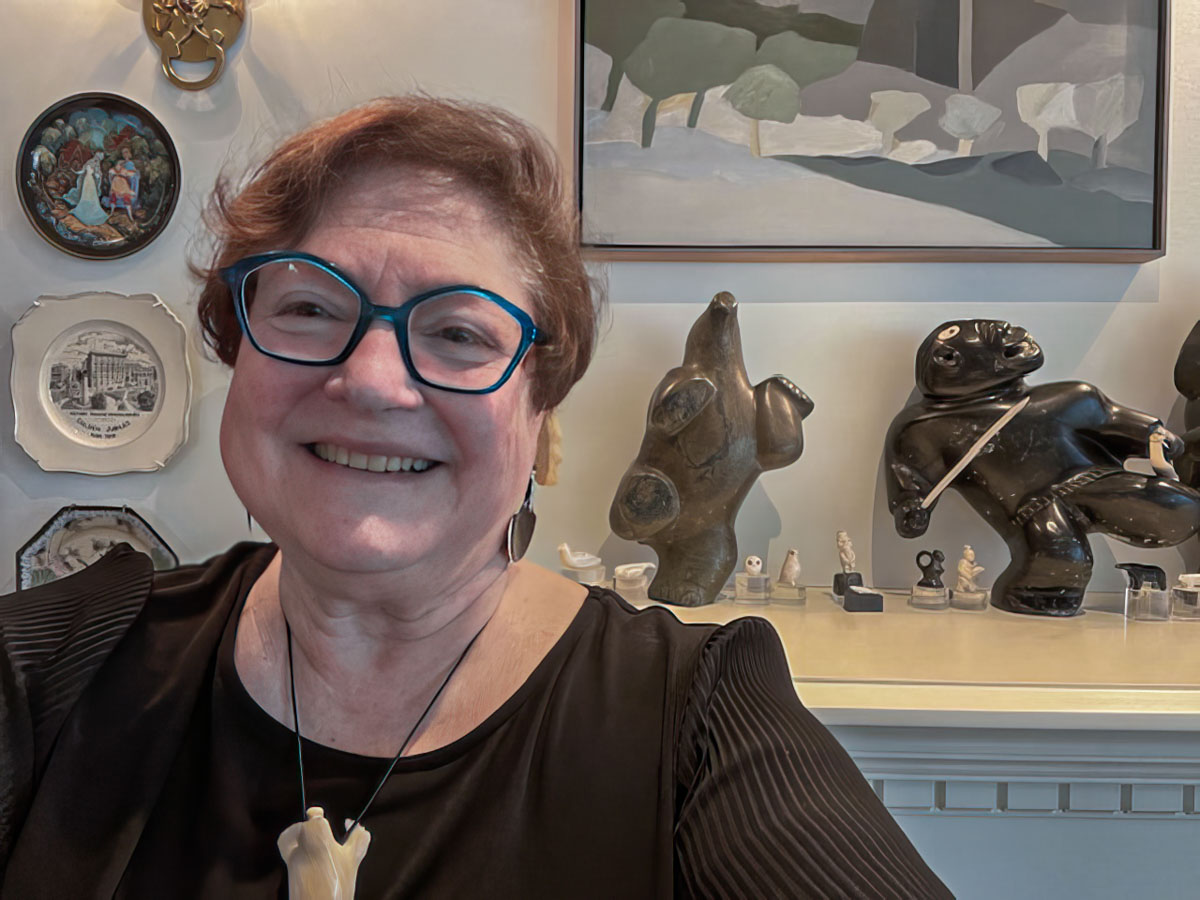
It seems that I have always been attracted to our North, to the Inuit people and their Art and I purchased my first sculpture in 1959, from the Vancouver Hudson’s Bay Co. using my own money saved up from baby sitting. That small seal from Belcher Island, now Sanikiluaq, is the cornerstone of my entire collection, because I still love the movement in the grain of the stone. I kept adding to my collection all through High School and University, but only with pieces that whispered to me. When People asked Gary and me what we wanted as a wedding gift, we said, “money toward an Inuit sculpture, please”. 3 sculptures were added after Feb. 3, 1969, as soon as we returned from our honeymoon.
After we came back from living in Israel for 2 years, we had our 3 daughters in 3 years, and then I decided that I needed to change professions and pursue what I had always wanted to do. So, I went back to University and received a Masters in Arctic Anthropology specializing in material culture of Arctic Cultures, and cultural art. I did my fieldwork in East Greenland and Copenhagen. It is what people create within their cultural boundaries that I find beautiful, fascinating and thoroughly absorbing……this art talks to me and tells me stories and I become enriched by it.
It was wonderful to finally become connected to the IAS, to meet the interesting people who are members, and to be able to see some of the fantastic collections that being a member of the society affords its members. It opens our eyes, our minds and our imaginations to see the incredible sculptures, prints and creations of the ‘old Masters’ and the newer ‘young artists’ – such creativity is seen nowhere else in such a small population yet is produced by so many as with the Inuit. It is so much fun to ‘talk shop’ with another individual who shares your passion and understanding, and I am sure that is why I enjoy the IAS meetings so thoroughly…….like people with like minds on like subjects !!!
I do have a major collection of Greenland Tupilaq Figures, many from my late brother, Lorne Balshine’s collection, including 7 Aron Kleist, 2 Cecelia Kleist, 3 Axel Nuko, 3 Rassmus Singertat and 6 Gedeon Qeqe. My Canadian collection includes my favourites that are a Pauta Polar bear and a seal, a Barnabus musk ox, a Joe Talirunilli owl, a Lucy Tasseor Sedna, a Pootoogook Qiatsuq drummer, an Andy Miki animal, an Abe Anghik Ruben multi animals, a George Arluk drummer, a Jonas Faber owl, a Pitsiolak Niviaqsi mother and child, a Judas Ulullaq man with bow and arrow, and an owl, an unknown 1959 seal, an unknown 1968 Arctic hare, a Johnnie Inukpuk Arctic hare, an unknown 1961 owl and a Nelson Taqiraq girl with dog.
I do have countless more sculptures, but I have only ever bought a sculpture because the stone was magnificent or the subject ’spoke to me’, or the carving was exquisitely executed. Inuit Art actually steals into my heart and my soul and I am captivated……I am addicted to it.
Hopefully, I will be able to be of some help to the society, and I will bring my knowledge and service to the society to the best of my ability. I look forward to the next year.
Chris Bredt, Board Member
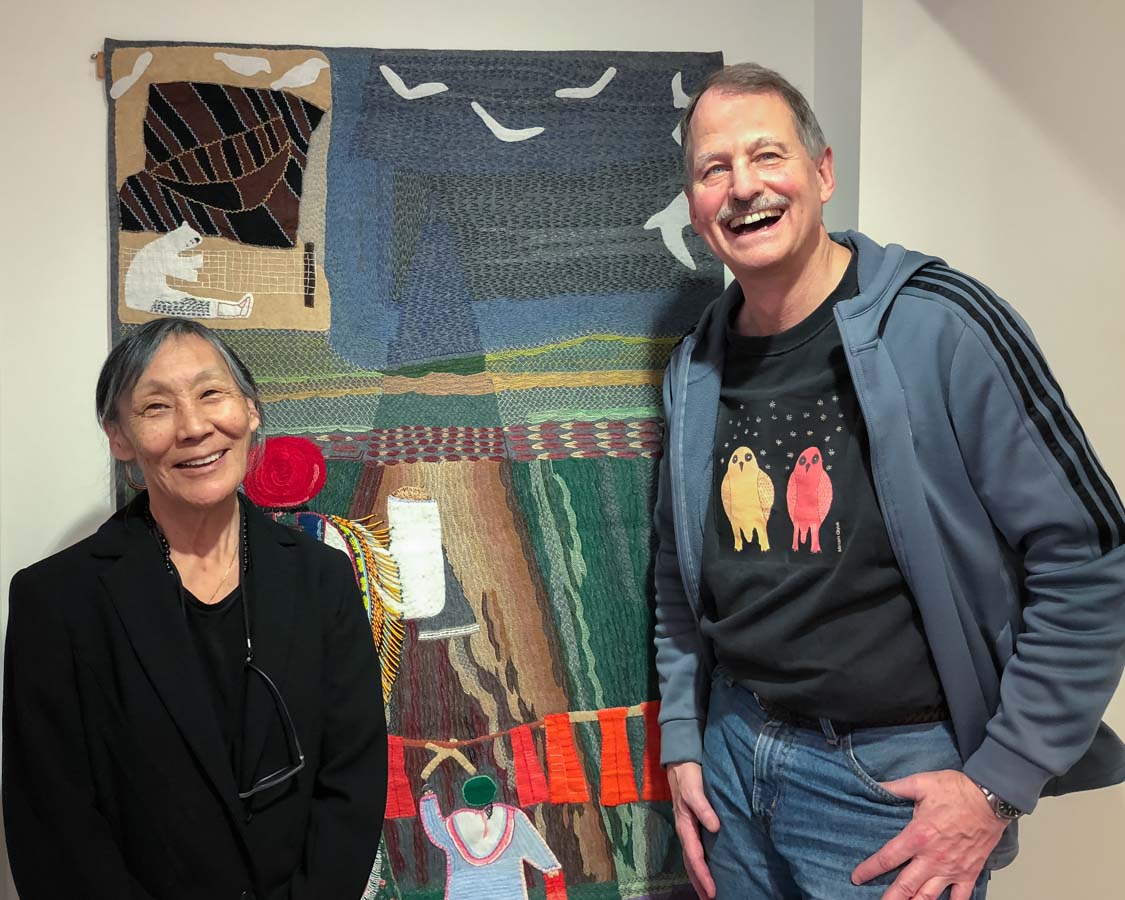
My spouse, Jamie Cameron, and I have been passionate collectors of Inuit art since 1987. We have travelled to the Arctic many times and frequently travel to Inuit art exhibitions across North America. We are both very involved with the McMichael Canadian Art Collection, which has one of the premier indigenous art collections in Canada. We have donated a large number of Inuit and Northwest Coast artworks to the McMichael and frequently sponsor exhibitions and publications. My wife and I have made many friends in the Inuit art world, including fellow collectors, dealers, curators, and especially artists. The photo attached is of Janet Nungnik (a textile artist from Baker Lake) and me at the opening of her exhibition at the Marion Scott Gallery.
Diane Ford, Board Member
I acquired an unforeseen and deep appreciation of Inuit Art through marriage, at the same time also acquiring an instant and extensive collection. The second time I met my husband Chris Rinner (also an IAS board member), he made sure I saw his collection of 60+ prints and hundreds of carvings and books just to make sure his enthusiasm and museum-like displays were not a deal breaker. Just the opposite, especially after he gave me a Cape Dorset green serpentine Sedna and a Helen Kalvak print to help seal the deal.
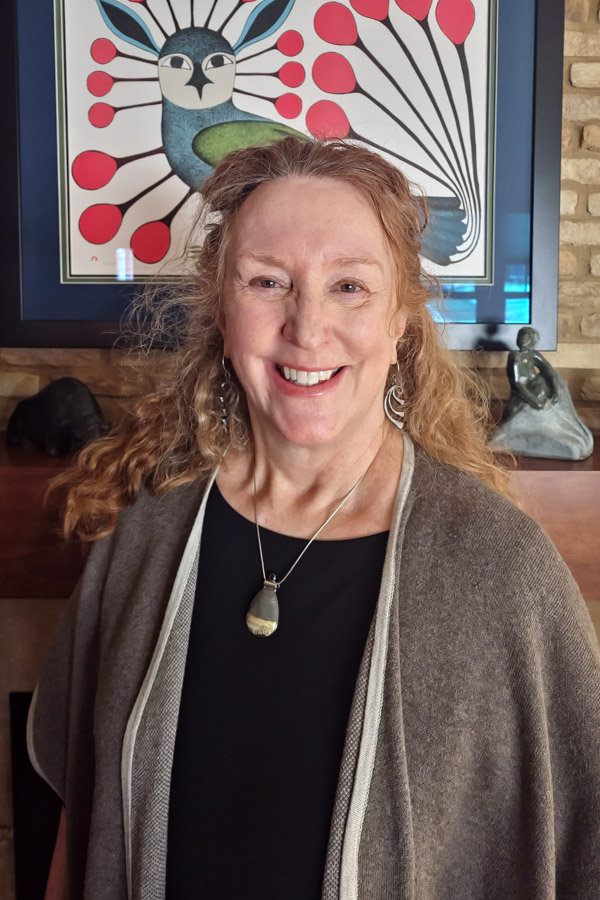
Over the years as I lived with and learned about the collection and the artists, I also became involved with the Inuit Art and Culture classes Chris taught. Chris and I started attending the IAS Conferences with the wonderful speakers, artists and museum tours.
Our Inuit art has become a significant part of our lives and by extension enabled an appreciation of this with our friends and families. Chris is a storyteller, and he showed the films of artists and traditional storytellers and told Inuit tales himself in his community education classes. He also regaled our grandchildren with these “bedtime” stories. Several years ago our grandson’s teacher was surprised and a little confused when she overheard him having a deep theological discussion with his friends in Kindergarten and told them that he believed in Sedna.
I have been involved over the past several years in planning and helping with the AIS conferences, and now look forward to serving on the board.
Chris Rinner, Board Member
In 2004 I was in a Victoria BC antique shop and I saw my first Inuit print, Kananginak Pootoogook’s “Summer Owl.” I was immediately taken with it. The owner then showed me several Inuit carvings for sale. There was a muskox carving by an unknown artist that particularly caught my eye, and when I held it in my hands the feeling was almost magical.
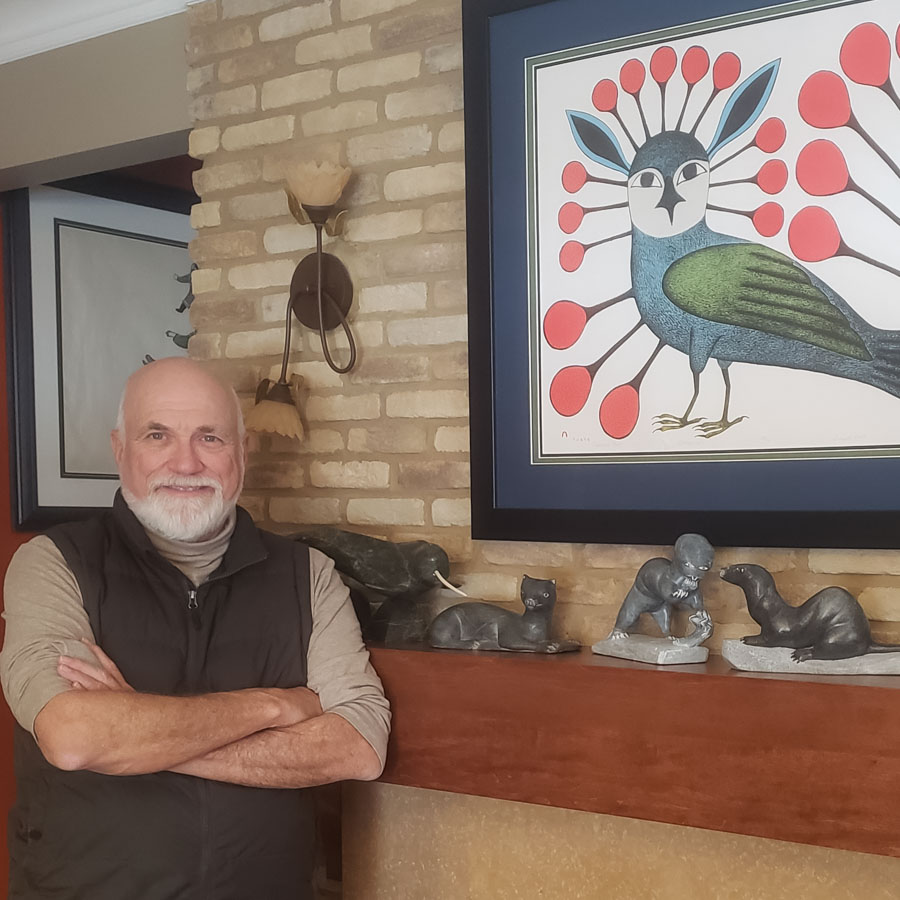
Those two purchases were the initial spark that ignited my interest in Inuit art. But it was when I attended the grand opening of the Toronto Museum of Inuit Art in 2007 that things really caught fire. After going through the exhibit, I was talking with one of the curators and, sensing my excitement, he offered to walk through the museum with me and provide additional information about the 3000 works of Inuit art on display. I left the museum 5 hours later completely hooked on Inuit art and eager to learn more. I have been an avid collector ever since.
In 2019 I attended the Inuit Art Society Conference in Ann Arbor, Michigan. That experience connected me to other kindred spirits fully appreciating Inuit art and the Inuit culture that produces it. The IAS opened a whole new opportunity to learn from fellow IAS members about this art I loved and the Inuit people that create it. As a retired educator, I was motivated to share what I was learning about Inuit art and culture through classes I taught at Drake University and the Senior College. It was very gratifying to see the interest and enthusiasm for Inuit art by so many Iowans.
Some of the artists in my collection I have particularly appreciated include graphic art by Kananginak Pootoogook, Lucy, Pitseolak Ashoona, Jessie Oonark, Pudlo Pudlat, Pitaloosie Saila, Kiakshuk, and Kenojuak Ashevak. My favorite carvers include George Arlook, Paul Kavik, Pits Qimirpik, Johanassie Eyaituq, Isaac Amitook, and Seepee Ipeelie.
Though still relatively new to the Inuit Art Society, I am grateful for the opportunity to be involved as a member of the IAS Board and continue my life-long learning about Inuit art and connecting with other enthusiasts working together to pursue and promote appreciation for Inuit art.
Karl Wielgus, Board Member
My interest in Inuit creations started in the late 1960s. I read a book by Edmund Carpenter on Inuit art and learned about a very different way to perceive, use material, and express a way of seeing that differed from my perspective. It was many years later that I directly experienced Inuit art and this increased my interest and desire to learn more about it. I went to my first Inuit Art Society conference in Indianapolis and it was a revelation. Art in many forms, throat singing, dancing, drumming, and information about Inuit culture all came together. I joined the Society because of this. Subsequently, I have attended meetings and as a result, I have gained a richer appreciation of Inuit culture.
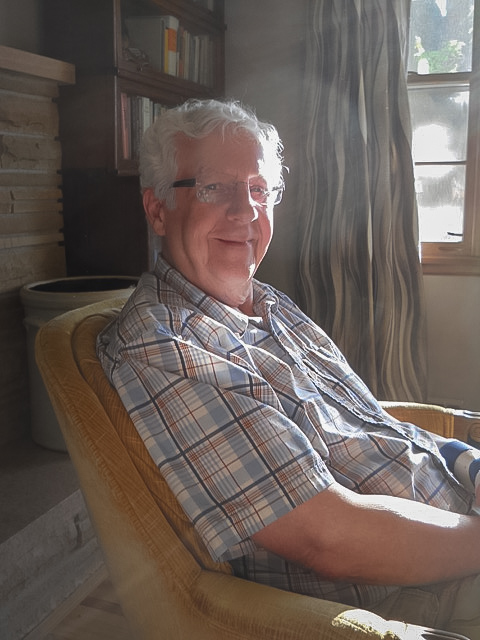
Of the many creations I experienced and came to know, I was especially drawn to the work of Floyd Kuptana. This interest led me to purchase a number of his works, all transformational images which I especially like. My interest in this connects to Inuit cultural ideas and beliefs that are alternative ways of perceiving that matter to me. Life forms are portrayed as dynamic forces that can change and are imbued with energies which are never static.
So much of Inuit art proffers a sense of the ways life forms connect to each other. These inter connections of human beings and the natural world are portrayed in many ways in different media. This relationship is often ignored in our culture. Inuit art helps us to be aware that how we see and experience the world around us is a consequence of the ways we look at and act on that world. There is much to learn from the life and processes around us. Whale, walrus, fish, seal, and caribou, as well as other life forms are interconnected with human life. Inuit culture helps us to see that relationship. We routinely use nature for our own ends and often fail to respect it as much as Inuit culture does. Transformation and the connections of human and animal life to the environment of which they are a part are central to this sensibility.
The experiences resulting from membership in the IAS have enhanced my life and spirit and serve as a doorway to a richer being in the world. I am appreciative of the opportunity to serve on the board and be a part of this process. I also believe that increasing awareness of Inuit art can offer significant benefits to people and look forward to assisting in achieving this.